Learning to swim or building water stamina often hits a frustrating wall. For young kids and swim learners, leg fatigue and fear of the deep end quickly turn an exciting afternoon at the pool into tears and hesitation. Meanwhile, traditional foam kickboards demand continuous, exhausting leg kicks that tire out beginners in minutes.
The modern electric swimming kickboard changes that dynamic completely. By integrating an ultra-quiet 300W underwater thruster, dual dead-man safety handles, and positive buoyancy into a sleek 7-pound board, it transforms swim practice into an effortless, exhilarating glide for both 5-year-olds and full-grown adults.
The Electric Swimming Kickboard at a Glance
| Product | Best For | Price & Demand Snapshot | Core Specs & Highlights | Friction Point Solved |
|---|---|---|---|---|
| Asiwo MAKO Electric Swimming Kickboard | Kids & adults swim assist, pool & lake fun | ~$269.99 (50+ bought/mo) | 3-speed (up to 1.5 m/s), 300W motor, 8kgf thrust, 60min battery, 265 lbs capacity | Eliminates leg fatigue & deep-water hesitation |
Prices & availability subject to change. Affiliate links may earn a commission at no extra cost to you.
1. Asiwo MAKO Electric Swimming Kickboard — High-Thrust Water Propulsion
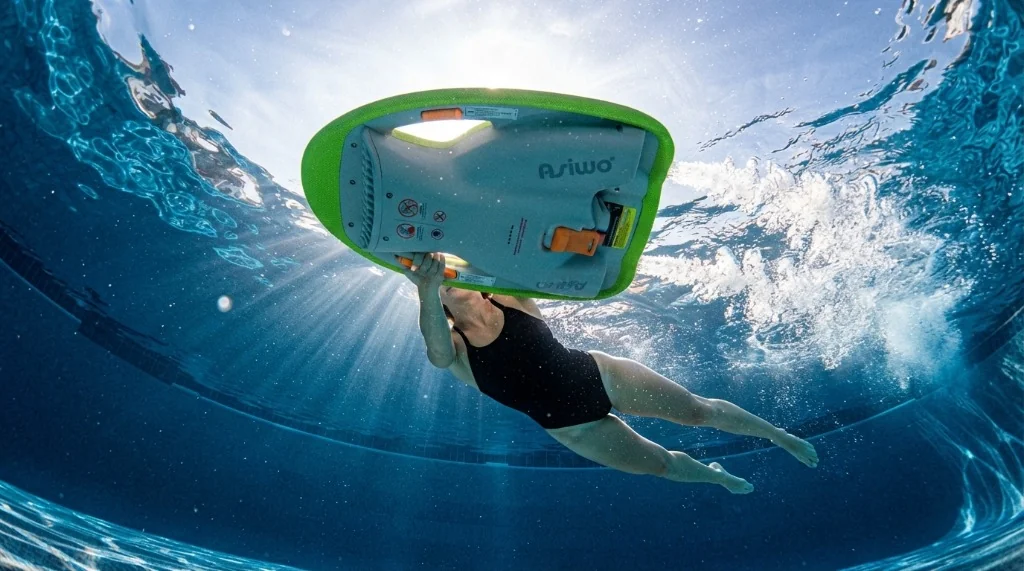
Traditional swim floats simply keep a swimmer afloat in one spot, forcing them to kick relentlessly to make any forward progress. The Asiwo MAKO pairs an aerodynamic, textured deck with an enclosed 300W brushless impeller beneath the hull, delivering up to 8kgf of steady, controllable forward thrust.
The feeling it adds: A weightless, flying-through-water sensation that lets swimmers practice streamlined breathing and horizontal body alignment without fighting exhaustion.
Key Design & Performance Highlights:
- 3-Speed Progressive Transmission: Toggles between Low (0.6 m/s for beginners and gentle water familiarization), Medium (1.0 m/s for steady cruising), and High (1.5 m/s for thrilling open-water glides and wave catching).
- Dual-Button Dead-Man Safety Activation: The motor activates strictly when both ergonomic side trigger buttons are held simultaneously. Releasing either hand cuts power in a fraction of a second, preventing the board from cruising away if a child lets go.
- Protective Propeller Grille: A heavy-duty, finger-proof intake cage completely encloses the impeller blades, ensuring complete safety against curious fingers or stray pool hair.
- Positive Buoyancy & 265 lbs Payload: Weighing just 7 lbs (3.2 kg), the board naturally floats on the surface. Even with a full-grown adult resting on top, the self-buoyant chamber prevents sinking regardless of battery status.
- 60-Minute Rechargeable Battery: The sealed 37V 2.5Ah lithium pack delivers up to 60 minutes of real-world cruising on low-speed mode, giving families ample time for an entire afternoon swimming session.
Before adding it: Always supervise young children around deep water, and ensure the magnetic charging port or battery seal is clean and completely dry before docking the charger.
Shop this find:
2. Progressive Learning: 3 Speed Modes for Beginners to Advanced Swimmers
An electric kickboard serves as a versatile progressive training tool across three distinct phases:
- Phase 1: Deep-End Confidence (Speed 1 — 0.6 m/s): For 5- to 8-year-old beginners, feeling the board effortlessly pull them across the deep end removes the panic of sinking. Swimmers learn to keep their head down, relax their neck muscles, and engage a gentle flutter kick.
- Phase 2: Stroke & Breathing Drills (Speed 2 — 1.0 m/s): Intermediate swimmers can practice side-breathing drills and rotational body balance without stalling out mid-lane.
- Phase 3: Lake & Coastal Gliding (Speed 3 — 1.5 m/s): Teens and adults can explore calm lake coves or ride gentle ocean swells, covering wide distances without burning out their stamina.
Battery Care & Saltwater Maintenance Guidelines
To maintain maximum thrust and extend the lifespan of your electric kickboard across multiple seasons:
- Freshwater Rinse After Every Use: Whether used in chlorinated pools or salty ocean water, thoroughly rinse the thruster grille and body with fresh tap water to prevent salt crystals or chlorine residue from crusting inside the motor bearings.
- Dry Before Charging: Never connect the charger while the contact pins are damp. Wipe down the charging terminal with a dry microfiber cloth and let it air-dry completely.
- Winter Storage Charge: If storing the board over the winter months, charge the lithium battery to approximately 50%–70% and keep it in a cool, dry indoor space to avoid deep self-discharge.
Prices & availability subject to change. Affiliate links may earn a commission at no extra cost to you.
FAQ
Can children use the electric kickboard safely on their own?
The Asiwo MAKO is engineered specifically with dual-button safety handles that require both hands to press and hold for operation. If a child lets go with either hand, the thruster immediately cuts off. Because the board has built-in positive buoyancy, it floats on top of the water even when powered off. However, adult supervision is always mandatory around any body of water.
Can an adult use this kickboard, or is it only for kids?
The board is rated for a maximum payload capacity of 265 lbs (120 kg). The 300W motor produces 8kgf of thrust, which provides plenty of propulsion to pull a full-grown adult smoothly through the water for leisurely snorkeling, swimming laps, or water aerobics.
Will fingers or hair get caught in the underwater propeller?
No. The motor impeller is housed inside a recessed intake chamber shielded by a high-density protective grille. The narrow grating gaps prevent fingers, toes, and loose swimwear from making contact with the rotating blades.
Can I take the electric kickboard on an airplane for vacation?
The Asiwo MAKO utilizes a 37V 2.5Ah (approx. 92.5Wh) rechargeable lithium battery pack. Because it falls below the FAA and IATA 100Wh limit for lithium-ion batteries, it is typically permitted in airline carry-on baggage. However, always verify specific airline carrier regulations before traveling.
How long does the battery take to recharge from empty?
A full recharge typically takes 2.5 to 3.5 hours using the standard included wall adapter. The LED charging indicator switches from red to solid green once the battery cells reach full capacity.